Task Switching Problem: How to Keep Your Brain Focused When Everything Feels Urgent
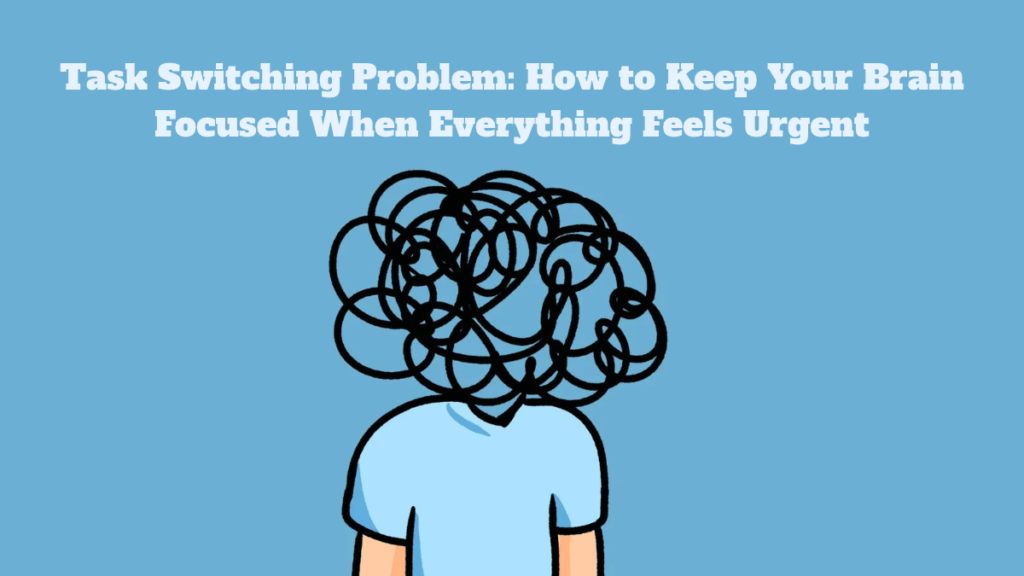
If your typical workday feels like a constant relay race between email threads, messaging apps, browser tabs, and half-written documents, you are likely suffering from cognitive friction. You start drafting a strategic memo, pause to answer a team ping, check a spreadsheet to verify a detail, remember a pressing deadline, and return to your memo only to find your focus completely drained.
This foggy, scattered feeling isn’t a discipline problem; it’s an attention problem. Research from the American Psychological Association, UC Irvine, and Dr. Sophie Leroy shows that jumping rapidly between tasks degrades cognitive clarity, creates persistent mental clutter, and drives up stress levels1.
Here is how you can restructure your workflow to eliminate daily mental handoffs, even when your job is fast-paced and full of interruptions.
The Cognitive Friction Cycle: Why We Switch Before Finishing
Most professionals don’t bounce between tasks because they lack focus; they do it because digital work creates an environment of constant open loops2. Every unfinished draft, unread message, or vague item on your to-do list acts like an open tab running in the background of your brain, consuming mental bandwidth.
When the next step on a high-priority task feels uncertain or demanding, your mind naturally seeks relief. Fast, low-effort activities, like clearing an email or replying to a chat, offer a quick sense of accomplishment. However, mistaking high movement for real productivity is the primary trap of modern knowledge work.
To break this loop, you don’t need a complete lifestyle overhaul. You simply need a reliable way to capture incoming distractions, clarify your immediate priorities, and create small, protected containers for high-value work.
Fast Switching vs. True Multitasking
It is a common misconception that knowledge workers can multitask. Aside from pairing low-cognitive physical habits with routine tasks (like pacing while on an audio call), the human brain cannot process two language-dependent or decision-heavy tasks at once.
When you attempt to write a proposal while keeping an eye on client messages, your brain is actually executing high-speed context switches. Each toggle requires your mind to unload one set of rules, tones, and goals, and reload another.
Over the course of an eight-hour day, these micro-reloads accumulate into significant time loss and mental exhaustion.
Quantifying the Attention Penalty
The hidden tax of constant task switching shows up across three main areas:
- Lost Time: The American Psychological Association notes that context-switching costs can consume up to 40% of an individual’s productive capacity, largely spent re-orienting to where work was left off.
- Attention Residue: Dr. Sophie Leroy’s research demonstrates that when you transition from Task A to Task B, a portion of your cognitive energy remains fixated on Task A, leaving you with reduced mental sharpness for the new task3.
- Stress and Fatigue: Studies from UC Irvine reveal that while interrupted workers often try to compensate by working faster, doing so leads to significantly elevated levels of stress, frustration, and mental strain4.
Five Practical Habits to Minimize Mental Handoffs
Instead of relying on willpower to resist distractions, implement these five structural boundaries:
- Maintain a Single Capture Note: When an unexpected request or random thought pops up during deep work, write it down in one central parking-lot note. Do not execute it immediately. Getting it out of your head closes the cognitive loop without derailing your current task.
- Group Low-Cognitive Work into Batches: Rather than checking communication tools continuously, schedule dedicated time windows to clear messages, handle administrative approvals, and process requests all at once.
- Work in Time-Bound Sprints: Commit to working on a single deliverable for 25 to 45 minutes without switching tabs. Give the sprint a tangible, singular objective (e.g., “Outline section two” rather than “Work on project”).
- Publish Clear Status Signals: Let your team know when you are in a focus block and explicitly share when you will next be available. Providing a designated channel for genuine emergencies keeps colleagues from interrupting your focus blocks unnecessarily (eg., setting a shareable status light).
- Establish an End-of-Day Transition: Spend the final ten minutes of your workday organizing tomorrow’s priorities, closing unnecessary browser tabs, and logging open loops so you can log off with complete mental clarity.

Key Takeaways for Overloaded Schedules
- Group similar tasks together to reduce gear-shifting during the day.
- Filter notifications by silencing non-essential alerts during focus sessions.
- Park incoming ideas on a dedicated list instead of taking immediate action.
- Limit active priorities to one clean, ordered daily list.
- Protect short sprints of 25 to 45 minutes to maintain steady forward momentum.
Restoring Focus to Your Workday
Overload and frequent distraction aren’t a personal failure; they’re the natural outcome of working in hyper-connected environments without boundaries. By clarifying your immediate next steps, batching routine communication, and protecting short blocks of single-task focus, you can dramatically lower the mental friction in your schedule and produce higher-quality work with less stress.
- https://www.apa.org/topics/research/multitasking ↩︎
- https://briancjensengrant.com/how-to-beat-task-switching-when-you-have-too-much-to-do/ ↩︎
- https://doi.org/10.1016/j.obhdp.2009.04.002 ↩︎
- https://www.ics.uci.edu/~gmark/chi08-mark.pdf ↩︎
0 Comments