Strategic Career Blueprinting: How to Map and Execute Your Professional Goals

Navigating a career trajectory without a concrete roadmap often leads to stagnant professional growth. Whether you are transitioning into a new industry, entering the job market, or targeting an executive promotion, establishing deliberate, structured objectives is essential for long-term success.
Below is a comprehensive framework to transform broad professional ambitions into achievable milestones.
1. Conduct a Professional Diagnostic
Before choosing a target destination, assess your current professional standing. Identify core competencies, technical gaps, and personal motivators to establish a baseline.
- Audit Strengths & Passions: Evaluate the tasks where you consistently perform best and determine which activities provide the highest job satisfaction.
- Identify Skill Gaps: Analyze the competencies required for your desired future roles versus your current skill set.
- Define Core Values: Determine the non-negotiables for your working environment, such as schedule flexibility, compensation expectations, organizational culture, or company mission.
2. Evaluate and Filter Opportunities
Once you identify prospective roles or industries, screen them against structured criteria to narrow your focus to 2–3 viable paths.
| Evaluation Metric | Key Considerations |
| Market Demand | Is the industry growing, or is it at risk of automation and contraction? |
| Value Alignment | Does this role support your target work-life balance and ethics? |
| Growth Potential | Are there clear advancement pathways over a 5- to 10-year horizon? |
| Earning Capacity | Does the compensation package meet your financial requirements? |
3. Map Risk vs. Reward Metrics
Every major career shift or target progression involves trade-offs. Weigh the prospective advantages against actionable challenges for your top choices before making a final selection.
Path A: Technical Leadership Transition
- Strategic Advantages: Exposure to high-visibility projects, increased earning potential, and influence over operational strategy.
- Execution Challenges: Requires master-level domain expertise, significant time invested in higher education or specialized certifications, and rigorous daily performance standards.
Path B: Entrepreneurship & Venture Creation
- Strategic Advantages: Complete autonomy over business direction, direct ownership of profit margins, and creative control.
- Execution Challenges: Initial capital requirements, income unpredictability during early growth, and high operational responsibilities.
4. Construct Your SMART Goal Matrix
Use the SMART framework (Specific, Measurable, Achievable, Relevant, Time-bound) to construct a tiered roadmap consisting of one primary long-term objective supported by sequential short-term benchmarks.
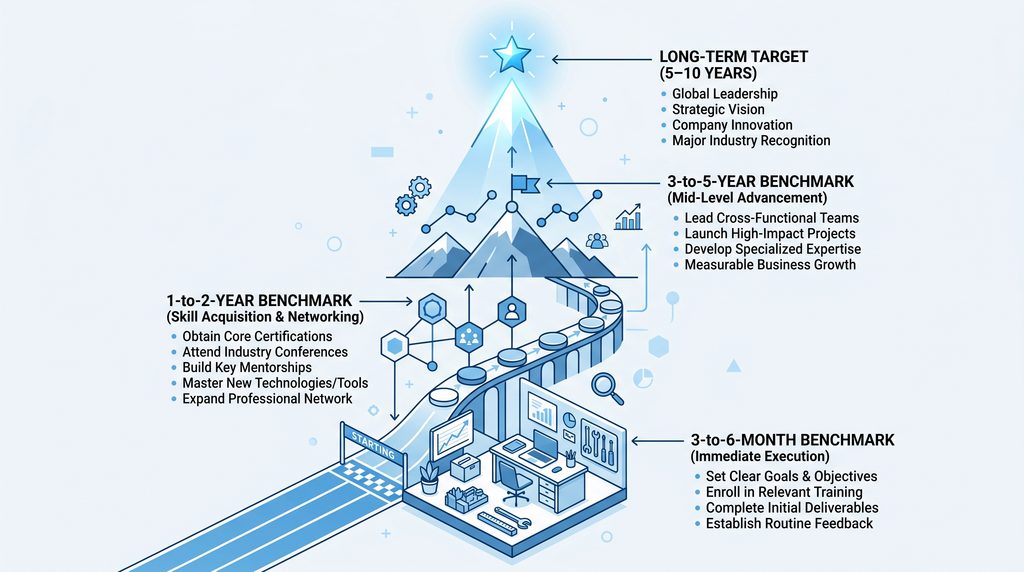
Action Plan 1: Enterprise Leadership Progression
- 10-Year Target: Secure a Senior Director position managing a multi-disciplinary team and supervising major operational budgets.
- 3–6 Months: Partner with an executive mentor to map out core competency benchmarks and commit to bi-weekly advisory sessions.
- 1 Year: Expand internal scope by leading cross-functional strategic projects outside daily duty requirements.
- 2 Years: Earn an industry-accredited management credential (e.g., PMP or Agile Leadership).
- 5 Years: Step into a department manager role, directly managing at least 2–3 team members.
Action Plan 2: Cross-Industry Career Pivot
- 5-Year Target: Complete a full transition into a senior role within a target secondary sector.
- 3 Months: Complete a comparative industry audit to map transferable skills to target job listings.
- 6 Months: Enroll in targeted technical coursework or a specialized bootcamp to bridge knowledge gaps.
- 1 Year: Build active relationships with at least 10 domain experts through professional associations and industry summits.
- 2 Years: Secure an entry-level or lateral transition role in the target field to build foundational tenure.
5. Implement Continuous Review Mechanics
Career trajectories are dynamic. Macroeconomic shifts, company realignments, and personal priorities require regular calibration of your baseline goals.
- Quarterly Reviews: Assess completed short-term milestones, measure progress against target deadlines, and adjust immediate execution tactics.
- Annual Audit: Re-evaluate your 5-to-10-year trajectory to ensure it still aligns with your evolving personal values and industry demands.
- Accountability Partners: Engage a trusted mentor, career advisor, or peer group to review progress updates and hold you accountable to set deadlines.
Thanks for stopping by! Got an interesting project or inquiry? Let’s talk.

0 Comments